Golf stretches for a more fluid swing @mayoclinicsport

Mayo Clinic Sports Medicine

@mayoclinicsport

It’s never too late to improve your golf swing. Our Mayo Clinic experts have the stretches to take your game to the next level:

Golf stretches can help get you ready for a day on the golf course. These golf stretches may help promote a fluid, full golf swing, which can improve your performance.

Warmup golf stretches

Before you start your golf stretches, you may want to warm up with 5 to 10 minutes of light activity, such as walking around the practice tee. If you have time, finish the full series of golf stretches found here. Hold each stretch for about 30 seconds.

Doing a single stretch one time is helpful. Do one set of golf stretches every day and another set before and after each round of golf.

Remember: Keep stretching gentle. Don’t bounce. If you feel pain, you’ve stretched too far.
Golf stretches for the quadriceps

Start off your golf stretches by first stretching the quadriceps. Quadriceps are the muscles in the front of the thighs. Start with this stretch:

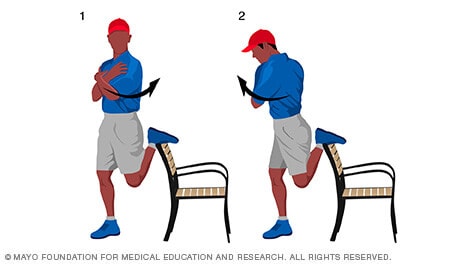
  • Stand with your back to a chair or bench and cross your arms over your chest. Place your left foot on the bench, as shown in image 1. You can use a chair or bench with a lower seat than the one shown here.
  • Keep your left knee even with or behind your right knee. Tighten the left buttock muscles. You’ll feel a stretch in the front of your left thigh.
  • To mimic your backswing, rotate your shoulders and torso to the right and bend your left shoulder and trunk slightly toward the ground, as shown in image 2.
  • Repeat the stretch on the opposite side.
Golf stretches for the back

Next, stretch the back muscles:

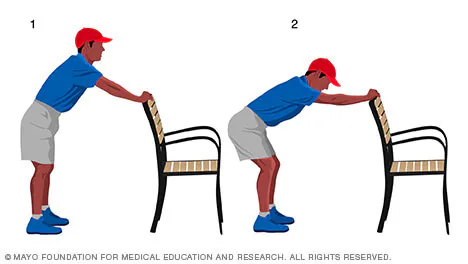
  • Stand with your feet apart, facing the back of a chair or bench.
  • Grasp the back of the bench with your hands, as shown in image 1.
  • Hold on to the bench and keep your spine straight. Move your body down and away from your hands until you feel a stretch near both armpits, as shown in image 2.
Golf stretches for the hamstrings

Now move on to the hamstrings. Hamstrings are the muscles in the back of the thighs. To do this stretch:

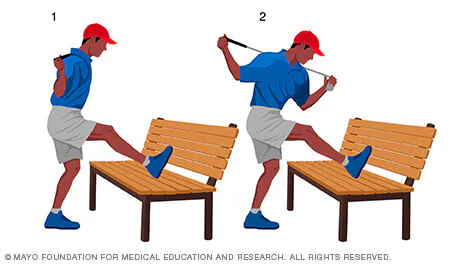
  • Hold your golf club behind your shoulders. Stand next to a step, low table or bench. Put your right foot on the bench and bend your right knee slightly, as shown in image 1.
  • Bend your upper body forward at your hips. Keep your spine straight until you feel a comfortable stretch in the back of your right thigh.
  • Hold this stretch while rotating your back and shoulders to the left and to the right, as shown in image 2.
  • Repeat the stretch on the opposite side.
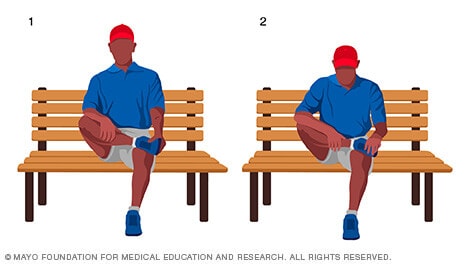
Golf stretches for the hips while seated

You can stretch your hips many ways. Try this seated stretch first:

  • Sit on a chair, low table or bench. Place your right ankle on top of your left thigh, as shown in image 1.
  • Push down on your right knee with your right forearm. Then lean forward at your waist until you feel a gentle stretch in your right hip, as shown in image 2.
  • Repeat the stretch on the opposite side.
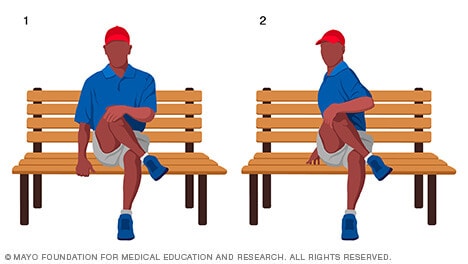
Golf stretches for the hips and back

Try this hip and back stretch:

  • Sit on a chair, low table or bench. Place your right ankle on top of your left thigh. Raise your right knee and grasp it with your left hand, as shown in image 1.
  • Keeping your spine straight, pull your right knee up toward your left shoulder. You’ll feel a stretch in your right buttock.
  • Mimic the position of your right hip when you’re at the top of your backswing by turning your shoulders to the right as shown in image 2.
  • Repeat the stretch on the opposite side.
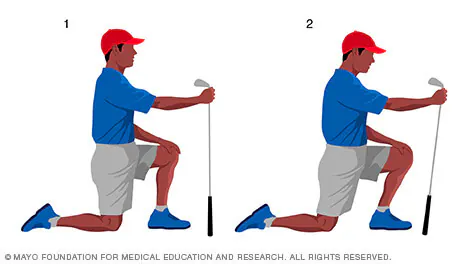
Golf stretches for the front hip muscles

Here’s a final hip stretch:

  • Kneel on your right knee and hold your golf club with your right hand. Place your left foot in front of you and bend your knee. Place your left hand on your left leg for stability, as shown in image 1.
  • Keep your back straight and abdominal muscles tight. Then lean forward, shifting more weight onto your left leg, as shown in image 2. You’ll feel a stretch in the front of your right hip and thigh.
  • Repeat the stretch on the opposite side.
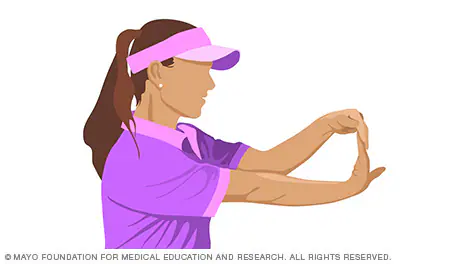
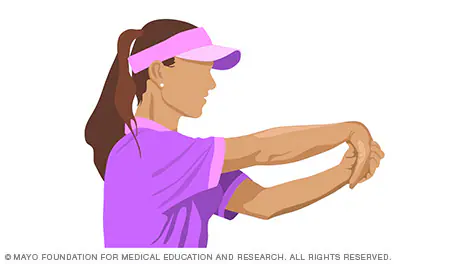
Golf stretches for the wrists

Now stretch your wrists upward:

  • Hold your right arm in front of you with your palm facing down.
  • Keep your elbow straight and gently pull your wrist up by grabbing the top of your fingers with your left hand.
  • Repeat the stretch on the opposite side.
More golf stretches for the wrists

Stretch your wrists downward too:

  • Hold your right arm in front of you with your palm facing down.
  • Keep your elbow straight and gently pull your wrist down with your left hand. You’ll feel the stretch in your right forearm and wrist.
  • Repeat the stretch on the opposite side.
Golf stretches for the shoulders

Next stretch your shoulders:

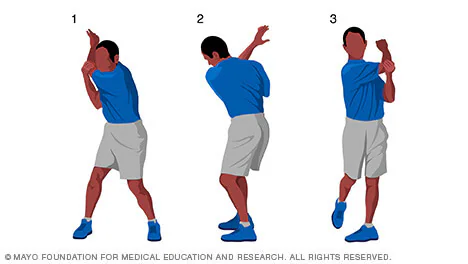
  • Stand with your feet shoulder-width apart as though you’re getting ready to hit the golf ball. Hold your left elbow with your right hand, as shown in image 1.
  • Keeping your left thumb pointed up, bend your left wrist toward your left thumb.
  • Rotate your trunk to the right.
  • Pull on your left elbow until you feel a stretch in your back, as shown in image 2.
  • To stretch your trailing shoulder — the right shoulder — grab your right elbow with your left hand. Then rotate your trunk to the left, as shown in image 3.
Golf stretches for the core muscles

Finally, stretch the core muscles:

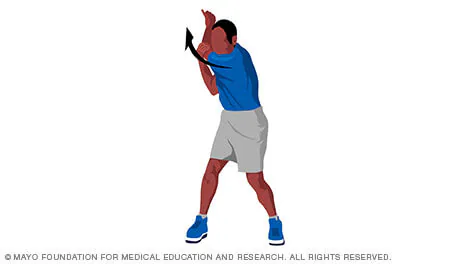
  • Stand with your feet shoulder-width apart, and fold your arms across your chest, as shown in image 1.
  • Bend your knees and lean forward slightly, as shown in image 2.
  • Rotate your trunk in your backswing motion, as shown in image 3.
  • Continue from the top of your backswing position to your follow-through, as shown in image 4.
  • At home, you may want to try this stretch in front of a mirror to check the different positions of your swing.

Originally published on Mayo Clinic

This Anything-Goes Green Goddess Salad is a Nutrition Goldmine @WomensRunning #fitnessaware

This Anything-Goes Green Goddess Salad is a Nutrition Goldmine

womensrunning.com

This Anything-Goes Green Goddess Salad is a Nutrition Goldmine

This green goddess salad recipe hits all the flavor and texture sweet spots and proves that green is indeed the color of health.

Makes 4 Servings

Ingredients

Salad

  • 1 Tbsp. sugar
  • 1 tsp. salt
  • 2/3 cup cider vinegar or white vinegar
  • 1 large green bell pepper, sliced
  • 1 cup green lentils
  • 1 cup freekeh
  • 1 (8 ounce) container of store-bought hummus
  • 4 cups arugula
  • 1 cucumber, chopped
  • 1 avocado, diced
  • 1/4 cup roasted shelled sunflower seeds

RELATED: I Tried This Hack for Better Sleep–And It Actually Worked

Dressing

  • 1 cup chopped zucchini
  • 1/4 cup extra virgin olive oil
  • 2 Tbsp. water
  • Juice of 1 lemon
  • 1/2 cup chopped parsley
  • 2 scallions (green onions), chopped
  • 1 jalapeño, seeded and chopped
  • 1 garlic clove, chopped
  • 2 Tbsp. tahini
  • 1 tsp. honey
  • 1/2 tsp. salt

Directions

  1. Place green pepper slices in a large wide-mouth jar or bowl. Place sugar and salt in a separate bowl and add 2/3 cup boiled water; stir until sugar and salt are dissolved. Stir in cider vinegar. Let cool for a few minutes and then add vinegar mixture to peppers. Cover and chill for at least 4 hours or up to several days.
  2. Cook lentils in a large saucepan of simmering, salted water until they are tender but still retain their shape, about 25 minutes. Drain, rinse under cold running water, and drain well again.
  3. Bring 2 1/2 cups water to a boil in a saucepan. Add freekeh and a couple pinches of salt. Reduce heat to medium/low and simmer covered until grains are tender, about 25 minutes. Drain any excess water.
  4. To make the dressing, blend together olive oil, water, zucchini, lemon juice, parsley, scallions, jalapeño, garlic, tahini, honey, and salt until smooth.
  5. To serve, spread hummus on serving plates and scatter on lentils, arugula, freekeh, cucumber, avocado, and sunflower seeds. Drizzle on dressing and garnish with microgreens if using.

Golf stretches for a more fluid swing @mayoclinicsport

Mayo Clinic Sports Medicine

@mayoclinicsport

It’s never too late to improve your golf swing. Our Mayo Clinic experts have the stretches to take your game to the next level:

Golf stretches can help get you ready for a day on the golf course. These golf stretches may help promote a fluid, full golf swing, which can improve your performance.

Warmup golf stretches

Before you start your golf stretches, you may want to warm up with 5 to 10 minutes of light activity, such as walking around the practice tee. If you have time, finish the full series of golf stretches found here. Hold each stretch for about 30 seconds.

Doing a single stretch one time is helpful. Do one set of golf stretches every day and another set before and after each round of golf.

Remember: Keep stretching gentle. Don’t bounce. If you feel pain, you’ve stretched too far.

Golf stretches for the quadriceps

Start off your golf stretches by first stretching the quadriceps. Quadriceps are the muscles in the front of the thighs. Start with this stretch:

  • Stand with your back to a chair or bench and cross your arms over your chest. Place your left foot on the bench, as shown in image 1. You can use a chair or bench with a lower seat than the one shown here.
  • Keep your left knee even with or behind your right knee. Tighten the left buttock muscles. You’ll feel a stretch in the front of your left thigh.
  • To mimic your backswing, rotate your shoulders and torso to the right and bend your left shoulder and trunk slightly toward the ground, as shown in image 2.
  • Repeat the stretch on the opposite side.

Golf stretches for the back

Next, stretch the back muscles:

  • Stand with your feet apart, facing the back of a chair or bench.
  • Grasp the back of the bench with your hands, as shown in image 1.
  • Hold on to the bench and keep your spine straight. Move your body down and away from your hands until you feel a stretch near both armpits, as shown in image 2.

Golf stretches for the hamstrings

Now move on to the hamstrings. Hamstrings are the muscles in the back of the thighs. To do this stretch:

  • Hold your golf club behind your shoulders. Stand next to a step, low table or bench. Put your right foot on the bench and bend your right knee slightly, as shown in image 1.
  • Bend your upper body forward at your hips. Keep your spine straight until you feel a comfortable stretch in the back of your right thigh.
  • Hold this stretch while rotating your back and shoulders to the left and to the right, as shown in image 2.
  • Repeat the stretch on the opposite side.

Golf stretches for the hips while seated

You can stretch your hips many ways. Try this seated stretch first:

  • Sit on a chair, low table or bench. Place your right ankle on top of your left thigh, as shown in image 1.
  • Push down on your right knee with your right forearm. Then lean forward at your waist until you feel a gentle stretch in your right hip, as shown in image 2.
  • Repeat the stretch on the opposite side.

Golf stretches for the hips and back

Try this hip and back stretch:

  • Sit on a chair, low table or bench. Place your right ankle on top of your left thigh. Raise your right knee and grasp it with your left hand, as shown in image 1.
  • Keeping your spine straight, pull your right knee up toward your left shoulder. You’ll feel a stretch in your right buttock.
  • Mimic the position of your right hip when you’re at the top of your backswing by turning your shoulders to the right as shown in image 2.
  • Repeat the stretch on the opposite side.

Golf stretches for the front hip muscles

Here’s a final hip stretch:

  • Kneel on your right knee and hold your golf club with your right hand. Place your left foot in front of you and bend your knee. Place your left hand on your left leg for stability, as shown in image 1.
  • Keep your back straight and abdominal muscles tight. Then lean forward, shifting more weight onto your left leg, as shown in image 2. You’ll feel a stretch in the front of your right hip and thigh.
  • Repeat the stretch on the opposite side.

Golf stretches for the wrists

Now stretch your wrists upward:

  • Hold your right arm in front of you with your palm facing down.
  • Keep your elbow straight and gently pull your wrist up by grabbing the top of your fingers with your left hand.
  • Repeat the stretch on the opposite side.

More golf stretches for the wrists

Stretch your wrists downward too:

  • Hold your right arm in front of you with your palm facing down.
  • Keep your elbow straight and gently pull your wrist down with your left hand. You’ll feel the stretch in your right forearm and wrist.
  • Repeat the stretch on the opposite side.

Golf stretches for the shoulders

Next stretch your shoulders:

  • Stand with your feet shoulder-width apart as though you’re getting ready to hit the golf ball. Hold your left elbow with your right hand, as shown in image 1.
  • Keeping your left thumb pointed up, bend your left wrist toward your left thumb.
  • Rotate your trunk to the right.
  • Pull on your left elbow until you feel a stretch in your back, as shown in image 2.
  • To stretch your trailing shoulder — the right shoulder — grab your right elbow with your left hand. Then rotate your trunk to the left, as shown in image 3.

Golf stretches for the core muscles

Finally, stretch the core muscles:

  • Stand with your feet shoulder-width apart, and fold your arms across your chest, as shown in image 1.
  • Bend your knees and lean forward slightly, as shown in image 2.
  • Rotate your trunk in your backswing motion, as shown in image 3.
  • Continue from the top of your backswing position to your follow-through, as shown in image 4.
  • At home, you may want to try this stretch in front of a mirror to check the different positions of your swing.

Originally published on Mayo Clinic

Passive stretching: 3 examples and benefits: @ClevelandClinic

health.clevelandclinic.org

What Is Passive Stretching?

Relax into this form of stretching while a prop or partner assists you

When you think of stretching, you might picture someone sitting on the floor, legs extended, reaching for their toes. But passive stretching takes a different approach. Instead of relying on your own flexibility, you use something (or someone) else to help.

Licensed massage therapist and registered nurse DeBorah Hill, RN, LMT, explains passive stretching and how it can benefit your health.

What is passive stretching?

Most people are familiar with dynamic and static stretching. Static stretching focuses on holding a pose that stretches your muscle as far as you can. Dynamic stretching uses movements, like walking lunges or hip circles, to warm up your muscles before an activity.

Dynamic and static stretches are limited to how far you can physically move. Think of toe touches: Some people can touch their toes and beyond, while others can’t reach their knees.

Passive stretching uses other forces to stretch your muscles, rather than your own ability. “During passive stretching, your body is loose and relaxed,” says Hill. “You let an external force — like a partner, towel or fitness strap — do the work.”

For example, instead of touching your toes, you can perform a passive hamstring stretch. During this stretch, you lie on your back and use a rolled-up towel or strap to help you stretch the back of your thigh. 

If you’re new to passive stretching, use care. You could accidentally stretch a muscle too much and cause injury.

“Listen to your body as you stretch,” advises Hill. “Passive stretching should not hurt, and many people overestimate how flexible they are. It’s helpful to talk with a licensed physical therapist or massage therapist before you start.”

Benefits of passive stretching

Consider adding passive stretching to your routine to:

Relieve stress

Unlike static or dynamic stretching, passive stretching requires your muscles to be relaxed for it to work. This release of physical tension can benefit your mental health.

“When you fully relax for a passive stretch, you tell your brain to shift out of fight-or-flight mode,” explains Hill. “Passive stretching can take you out of survival mode so you feel relaxed.”

Increase flexibility

One study found passive stretching to be better than dynamic stretching at increasing hamstring flexibility.

“Passive stretching can increase your range of motion when other stretches don’t work for you,” says Hill. “Your prop or partner can help you gently stretch beyond what you can normally do yourself.”

Overcome mobility limitations

If you have mobility issues or chronic pain, other forms of stretching can be difficult. Passive stretching works for people of all ages and fitness levels. Can’t bend over or move your body a certain way? Passive stretches can work around these limitations.

Examples of passive stretching

Passive stretches can work many different muscles. Try these stretches to get started:

1. Doorway stretch

This stretch focuses on your chest and shoulders:

  1. Stand just behind a doorway.
  2. Place one foot slightly in front of the other for stability.
  3. Raise your arms to the side with your elbows bent at 90 degrees, palms facing forward like goal posts. Allow your elbows, forearms and palms to press against the doorframe.
  4. Gently lean forward, keeping your arms on the doorframe.
  5. Hold for 10 seconds.
  6. Rest for five seconds and repeat.

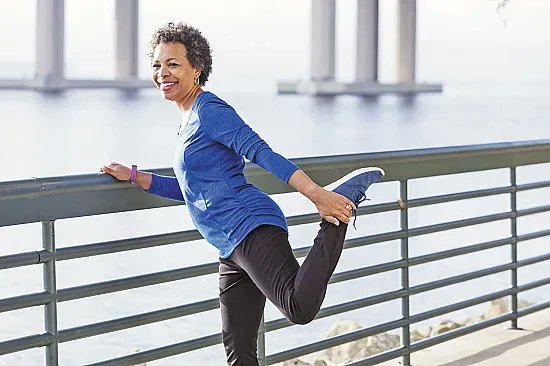
2. Standing quad stretch

This passive stretch focuses on your quadriceps, or the muscles on the front of your thighs:

  1. Stand next to a steady object, such as a table or wall, that can be used for balance.
  2. Loop a rolled-up towel or fitness strap around your right ankle.
  3. Hold the other end of the towel or strap with your right hand.
  4. Place your left hand on the table or wall for balance.
  5. Slowly bend your right knee and pull your right foot up toward your buttocks using the towel or strap.
  6. Hold for up to 30 seconds.
  7. Repeat on the opposite leg.

3. Towel hamstring stretch

The backs of your legs, or hamstrings, get a stretch here — no toe-touching required:

  1. Lie on your back, with your legs straight and relaxed.
  2. Slowly raise one leg up toward the ceiling without bending your knee, keeping your leg relaxed.
  3. Hook the towel or strap behind your hamstring or calf or under the arch of your foot, depending on what’s comfortable for you.
  4. Using your towel or strap, gently pull your leg towards you until you feel the stretch.
  5. Hold for up to 30 seconds.
  6. Switch legs.

A stretching routine is worth it

Taking a few minutes a day to stretch has big benefits, from preventing injuries to reducing joint pain. And if other forms of stretching haven’t worked for you, passive stretching is worth a try.

“The beauty of passive stretching is that it works for so many people,” states Hill. “Whether you’re just starting out or you’re an elite athlete, passive stretching can help you feel great physically and mentally.”

Knead, stretch, awaken your qi: here’s the right way to tackle recovery depends on where in the world you are.@WomensRunning #physiotherapy

Toward the end of a long run your calf is in a knot the size of a grapefruit. Is this an over-excited neuron taking out its anxiety on a muscle? Or is your qi depleted? You may need a new recovery technique.

Western hemisphere physios of yore saw the body as an organization of bones, muscles, fascia, and nerves, so bodywork that originated there, like Swedish massage, attempts to heal and realign those parts.

Eastern folk saw the body as a vessel of energy and breath. Bodywork that grew out of that philosophy, like acupressure, sought to open blocked energy pathways and restore balance.

Here’s a quick look at three types of bodywork from around the world—three philosophies—that can be used as prevention during training, or for recovery from an injury or race.

Recovery Modalities From Around The World

Shiatsu
Origin: Japan

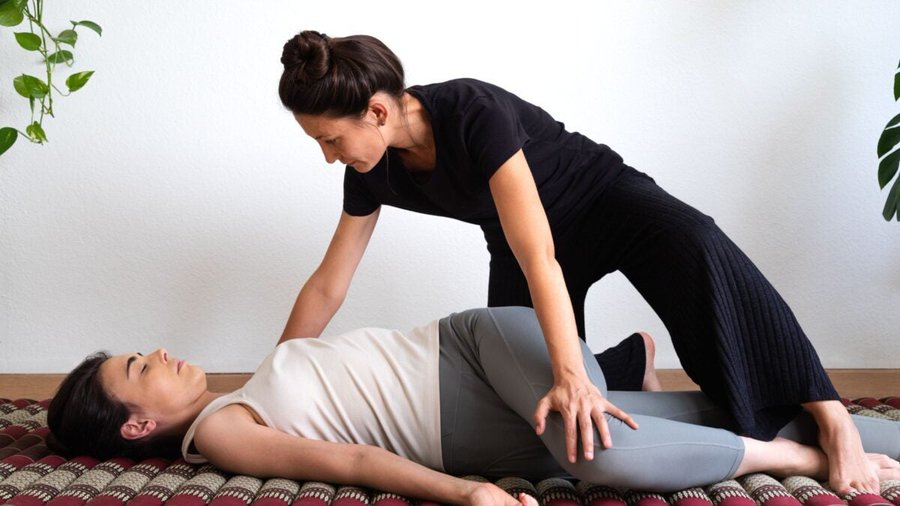
Shiatsu is based on theories of acupuncture and Chinese medicine that were imported to Japan around 5 AD. According to Cari Johnson Pelava, director of Centerpoint Massage & Shiatsu Therapy School & Clinic, in Minneapolis, a system of energy, “qi,” runs through the body on pathways, and along those pathways lie points where one can access that energy to make a difference in the body. Symptoms like pain or fatigue are said to be caused by an imbalance of energy. By applying pressure, kneading, and stretching, a shiatsu therapist can restore the body’s energy balance.

“We’ve worked with triathletes pre-event and post,” Johnson Pelava says. “Pre-event we’ll focus on tonifying energy so that it’s most accessible to the athlete on event day. We’ll do stretching, hip rotations, and other range of motion work to open energetic pathways. Post-event, we’ll work deeper to pull that energy that’s been depleted back.”

Thai Yoga
Origin: Thailand

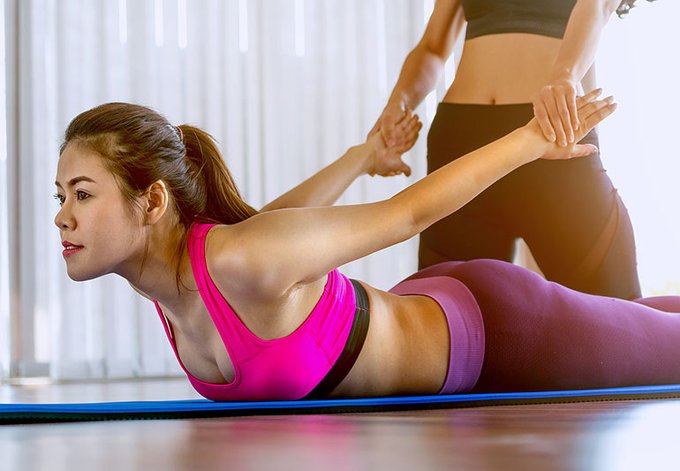
Thai yoga bodywork has an eastern flavor informed by yoga, Ayurveda, and Buddhism. It combines rhythmic massage, assisted yoga poses, acupressure along energy meridians, healing energy work, and meditation.

Tanya Boigenzahn, director of Devanadi School of Yoga and Wellness in Minneapolis, says Thai yoga bodywork can help athletes with flexibility, alignment, and breath control, as well as their mental game—mood, concentration, confidence.

Thai yoga is accomplished in a one-on-one session with clothes on. The therapist moves a passive client through positions, stretching tight areas, and encouraging range of motion and mindful breathwork.

Boigenzahn says Thai yoga helps optimize training pre-event, and eases recovery afterward. “Athletes can expect to have a quicker bounce back time, as well as less discomfort after a tough event.”

Rolfing
Origin: USA

Ida Rolf thought that pain, inefficient movement, and imbalance was were the result of the body being improperly organized around its axis. In New York during the 1940s, Rolf began reorganizing clients’ bodies by manipulating fascia—the connective tissue separating muscles and other organs— which developed into the therapeutic approach called Rolfing Structural Integration. “It’s a combination of participatory bodywork and active experimentation with body movement education,” says Kevin McCarthy, an advanced rolfer with In|Form Rolfing in Minneapolis. “We teach clients how to be aware of and work with their body for better function.”

Rolfing is a holistic approach that seeks to find the source of the dysfunction rather than merely treat the symptom. “Participatory” is a key word, McCarthy says.

“Unlike most forms of massage where you’re lying passively on a table, we’re asking, ‘Can you stand up using the outside of your leg? Do you notice the difference in how that feels?’” he says. “We’re using the body to repattern the brain.”

Because it involves education, rolfing is not a one-and-done—a rolfing treatment is actually usually a series of 10 sessions.

Sports nutrition isn’t just about protein shakes. A dietitian breaks down how hydration, timing and balance impact results. @ClevelandClinic

What Athletes Need To Know About Sports Nutrition

Having a well-rounded, healthy nutrition plan is just as important as staying consistent with your exercise routine

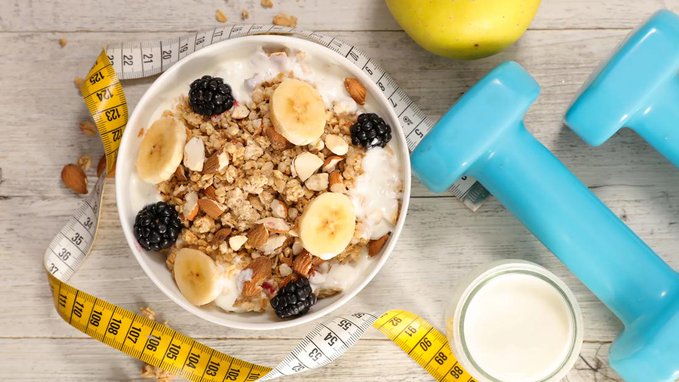
When you’re an athlete racking up miles and muscle, your body needs extra fuel to keep up with the amount of exercise you’re doing and help speed up recovery. That’s what makes sports nutrition so important — it offers you a path to making sure you’re getting all the nutrients you need, even as you sweat.

Sports and nutrition

For the most part, athletes will eat higher quantities of food more often than non-athletes because food is equivalent to energy. But that isn’t always the case, and some meal plans may work better for you than for someone else.

“Everyone’s body is very different, so it’s really important that we specialize individualized nutrition plans,” says registered dietitian Carly Sedlacek, RD, LD.

Bringing your physical fitness goals to a dietitian can help provide you with a holistic, balanced and personalized approach to eating healthy beyond simply counting calories. If you’re trying to build muscle, for example, your goals for nutrition will likely be different from someone who’s trying to lose weight.

Overall, when sports nutrition is combined with consistent exercise, it can boost your performance and help you feel great, even on rest days. Regardless of your goals, the following areas of sports nutrition can help.

Hydration

When you exercise, you lose a lot of water and electrolytes through sweating. Drinking enough water before a training session and throughout a workout can help replenish what’s lost.

At minimum, you should drink about 16 ounces of water two to three hours before exercise, and about 4 ounces every 15 to 20 minutes while exercising. It’s also important to make sure you’re drinking plenty of water throughout the entire day.

Sometimes, athletes prefer to use sports drinks after exercising because they’re packed with electrolytes to replace what was lost in sweat. “Electrolyte beverages should be used during activities lasting longer than 60 minutes,” says Sedlacek. “If you have a history of chronic disease or conditions, check with your doctor before including higher sodium beverages.”

Carbohydrates

Carbohydrates are your body’s main source of energy. While carbs are not the only food you should focus on, they should be something you consider as part of every meal, especially in the hours leading up to a workout or training session.

“Before exercising, you want to stick with foods that tend to digest easily, including some carbohydrate sources like fruits (bananas, apples or oranges), oatmeal or rice,” advises Sedlacek. “If you’re doing a longer workout routine that’s more than an hour long, you’ll want carbohydrates during that time to get that boost of quick-acting energy.”

Protein

Protein is the building block for your muscles. Without it, muscle recovery slows, along with your ability to build muscle mass. In general, you should try and get most of your protein from whole food sources like:

  • Salmon and other fish
  • Eggs and egg whites
  • Greek yogurt
  • Beans and legumes
  • Chicken
  • Tofu
  • Low-fat cheeses

But when you’re short on time, you can turn to protein powders or protein shakes between meals, in addition to having some protein at every meal.

“Protein helps with muscle recovery,” shares Sedlacek. “Getting at least 25 to 35 grams of protein right after exercise is helpful because that’s when your body prefers to use it.”

Fats

In general, having a healthy, well-rounded diet that incorporates an abundance of fruits, vegetables and plant- or animal-based sources of protein is key. That means healthy fats (like olive oil, avocado and fatty fish) also play a role as a secondary source of energy. Not only do they fill you up faster, but they also help your body better process other micronutrients, like fat-soluble vitamins.

Supplements

When it comes to supplements (like protein powders or pre-workout beverages), you want to use them sparingly. As you’re consuming more than the general population to keep up with your level of athleticism, supplements should be used to fill in a gap and not as a meal replacement.

“We want to try and stick to a food-first approach the best we can because the body is able to utilize those sources a little bit better than supplements,” explains Sedlacek.

Timing

When it comes to meals and snacks, timing is everything. You should try to aim for three spaced-out meals a day with snacks in between each meal. When it comes to exercise, you’ll want to have something small to eat (usually carbs or protein) at least an hour or two before exercising and immediately after a workout.

“It’s important to be consistent,” states Sedlacek. “If we’re going into an exercise and we don’t have enough energy to pull from, our body can end up pulling energy from our muscles. So, it’s important to have something small to eat before working out.”

Next steps

Sports nutrition can require a lot of fine-tuning, especially when you’re just getting started. Working with a dietitian and a physical fitness trainer can help get you the support you need for your specific situation.

And if at any point you feel lightheaded, dizzy or even experience hunger pangs, it might be a result of not eating enough or having enough water to keep up with the physical demands of exercise. In those cases, trying to level out your blood sugars and electrolytes is important, as well as seeing a healthcare provider if issues continue.