Golf stretches for a more fluid swing @mayoclinicsport

Mayo Clinic Sports Medicine

@mayoclinicsport

It’s never too late to improve your golf swing. Our Mayo Clinic experts have the stretches to take your game to the next level:

Golf stretches can help get you ready for a day on the golf course. These golf stretches may help promote a fluid, full golf swing, which can improve your performance.

Warmup golf stretches

Before you start your golf stretches, you may want to warm up with 5 to 10 minutes of light activity, such as walking around the practice tee. If you have time, finish the full series of golf stretches found here. Hold each stretch for about 30 seconds.

Doing a single stretch one time is helpful. Do one set of golf stretches every day and another set before and after each round of golf.

Remember: Keep stretching gentle. Don’t bounce. If you feel pain, you’ve stretched too far.
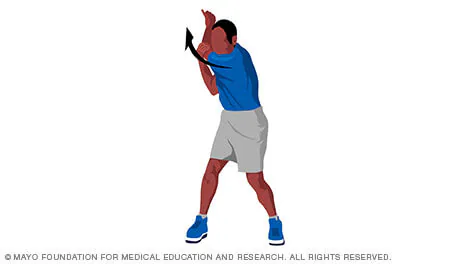
Golf stretches for the quadriceps

Start off your golf stretches by first stretching the quadriceps. Quadriceps are the muscles in the front of the thighs. Start with this stretch:
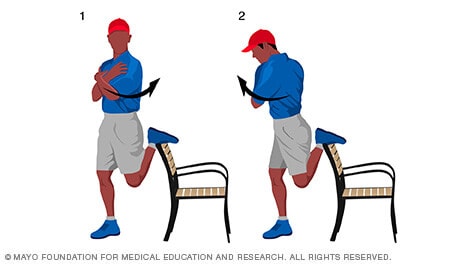
  • Stand with your back to a chair or bench and cross your arms over your chest. Place your left foot on the bench, as shown in image 1. You can use a chair or bench with a lower seat than the one shown here.
  • Keep your left knee even with or behind your right knee. Tighten the left buttock muscles. You’ll feel a stretch in the front of your left thigh.
  • To mimic your backswing, rotate your shoulders and torso to the right and bend your left shoulder and trunk slightly toward the ground, as shown in image 2.
  • Repeat the stretch on the opposite side.

Golf stretches for the back

Next, stretch the back muscles:

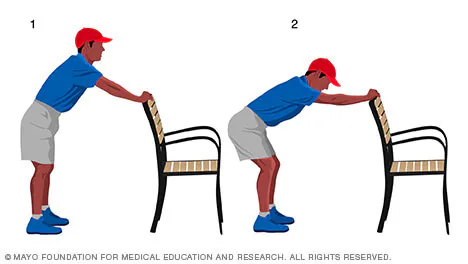
  • Stand with your feet apart, facing the back of a chair or bench.
  • Grasp the back of the bench with your hands, as shown in image 1.
  • Hold on to the bench and keep your spine straight. Move your body down and away from your hands until you feel a stretch near both armpits, as shown in image 2.

Golf stretches for the hamstrings

Now move on to the hamstrings. Hamstrings are the muscles in the back of the thighs. To do this stretch:
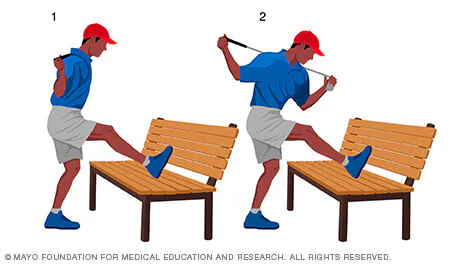
  • Hold your golf club behind your shoulders. Stand next to a step, low table or bench. Put your right foot on the bench and bend your right knee slightly, as shown in image 1.
  • Bend your upper body forward at your hips. Keep your spine straight until you feel a comfortable stretch in the back of your right thigh.
  • Hold this stretch while rotating your back and shoulders to the left and to the right, as shown in image 2.
  • Repeat the stretch on the opposite side.

Golf stretches for the hips while seated

You can stretch your hips many ways. Try this seated stretch first:
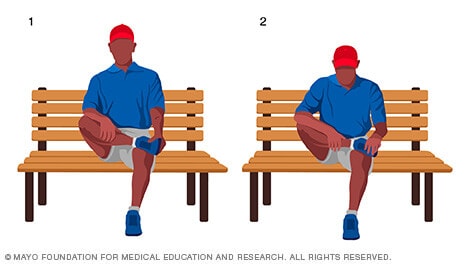
  • Sit on a chair, low table or bench. Place your right ankle on top of your left thigh, as shown in image 1.
  • Push down on your right knee with your right forearm. Then lean forward at your waist until you feel a gentle stretch in your right hip, as shown in image 2.
  • Repeat the stretch on the opposite side.

Golf stretches for the hips and back

Try this hip and back stretch:

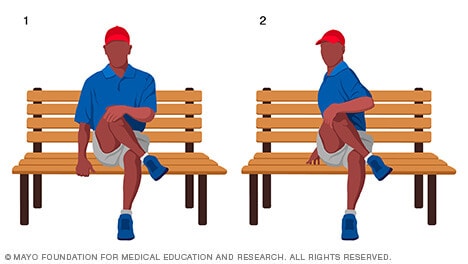
  • Sit on a chair, low table or bench. Place your right ankle on top of your left thigh. Raise your right knee and grasp it with your left hand, as shown in image 1.
  • Keeping your spine straight, pull your right knee up toward your left shoulder. You’ll feel a stretch in your right buttock.
  • Mimic the position of your right hip when you’re at the top of your backswing by turning your shoulders to the right as shown in image 2.
  • Repeat the stretch on the opposite side.

Golf stretches for the front hip muscles

Here’s a final hip stretch:

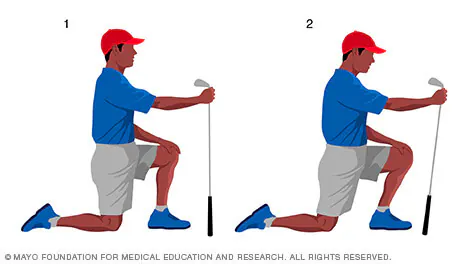
  • Kneel on your right knee and hold your golf club with your right hand. Place your left foot in front of you and bend your knee. Place your left hand on your left leg for stability, as shown in image 1.
  • Keep your back straight and abdominal muscles tight. Then lean forward, shifting more weight onto your left leg, as shown in image 2. You’ll feel a stretch in the front of your right hip and thigh.
  • Repeat the stretch on the opposite side.

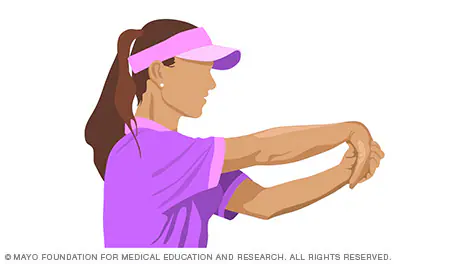
Golf stretches for the wrists

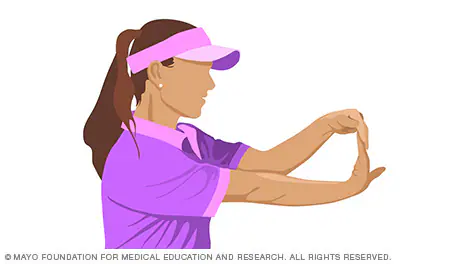
Now stretch your wrists upward:

  • Hold your right arm in front of you with your palm facing down.
  • Keep your elbow straight and gently pull your wrist up by grabbing the top of your fingers with your left hand.
  • Repeat the stretch on the opposite side.

More golf stretches for the wrists

Stretch your wrists downward too:

  • Hold your right arm in front of you with your palm facing down.
  • Keep your elbow straight and gently pull your wrist down with your left hand. You’ll feel the stretch in your right forearm and wrist.
  • Repeat the stretch on the opposite side.

Golf stretches for the shoulders

Next stretch your shoulders:

  • Stand with your feet shoulder-width apart as though you’re getting ready to hit the golf ball. Hold your left elbow with your right hand, as shown in image 1.
  • Keeping your left thumb pointed up, bend your left wrist toward your left thumb.
  • Rotate your trunk to the right.
  • Pull on your left elbow until you feel a stretch in your back, as shown in image 2.
  • To stretch your trailing shoulder — the right shoulder — grab your right elbow with your left hand. Then rotate your trunk to the left, as shown in image 3.

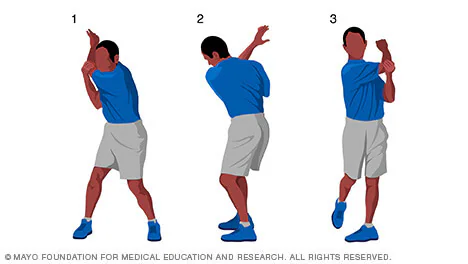
Golf stretches for the core muscles

Finally, stretch the core muscles:

  • Stand with your feet shoulder-width apart, and fold your arms across your chest, as shown in image 1.
  • Bend your knees and lean forward slightly, as shown in image 2.
  • Rotate your trunk in your backswing motion, as shown in image 3.
  • Continue from the top of your backswing position to your follow-through, as shown in image 4.
  • At home, you may want to try this stretch in front of a mirror to check the different positions of your swing.

Originally published on Mayo Clinic

Golf stretches for a more fluid swing @mayoclinicsport

Mayo Clinic Sports Medicine

@mayoclinicsport

It’s never too late to improve your golf swing. Our Mayo Clinic experts have the stretches to take your game to the next level:

Golf stretches can help get you ready for a day on the golf course. These golf stretches may help promote a fluid, full golf swing, which can improve your performance.

Warmup golf stretches

Before you start your golf stretches, you may want to warm up with 5 to 10 minutes of light activity, such as walking around the practice tee. If you have time, finish the full series of golf stretches found here. Hold each stretch for about 30 seconds.

Doing a single stretch one time is helpful. Do one set of golf stretches every day and another set before and after each round of golf.

Remember: Keep stretching gentle. Don’t bounce. If you feel pain, you’ve stretched too far.

Golf stretches for the quadriceps

Start off your golf stretches by first stretching the quadriceps. Quadriceps are the muscles in the front of the thighs. Start with this stretch:

  • Stand with your back to a chair or bench and cross your arms over your chest. Place your left foot on the bench, as shown in image 1. You can use a chair or bench with a lower seat than the one shown here.
  • Keep your left knee even with or behind your right knee. Tighten the left buttock muscles. You’ll feel a stretch in the front of your left thigh.
  • To mimic your backswing, rotate your shoulders and torso to the right and bend your left shoulder and trunk slightly toward the ground, as shown in image 2.
  • Repeat the stretch on the opposite side.

Golf stretches for the back

Next, stretch the back muscles:

  • Stand with your feet apart, facing the back of a chair or bench.
  • Grasp the back of the bench with your hands, as shown in image 1.
  • Hold on to the bench and keep your spine straight. Move your body down and away from your hands until you feel a stretch near both armpits, as shown in image 2.

Golf stretches for the hamstrings

Now move on to the hamstrings. Hamstrings are the muscles in the back of the thighs. To do this stretch:

  • Hold your golf club behind your shoulders. Stand next to a step, low table or bench. Put your right foot on the bench and bend your right knee slightly, as shown in image 1.
  • Bend your upper body forward at your hips. Keep your spine straight until you feel a comfortable stretch in the back of your right thigh.
  • Hold this stretch while rotating your back and shoulders to the left and to the right, as shown in image 2.
  • Repeat the stretch on the opposite side.

Golf stretches for the hips while seated

You can stretch your hips many ways. Try this seated stretch first:

  • Sit on a chair, low table or bench. Place your right ankle on top of your left thigh, as shown in image 1.
  • Push down on your right knee with your right forearm. Then lean forward at your waist until you feel a gentle stretch in your right hip, as shown in image 2.
  • Repeat the stretch on the opposite side.

Golf stretches for the hips and back

Try this hip and back stretch:

  • Sit on a chair, low table or bench. Place your right ankle on top of your left thigh. Raise your right knee and grasp it with your left hand, as shown in image 1.
  • Keeping your spine straight, pull your right knee up toward your left shoulder. You’ll feel a stretch in your right buttock.
  • Mimic the position of your right hip when you’re at the top of your backswing by turning your shoulders to the right as shown in image 2.
  • Repeat the stretch on the opposite side.

Golf stretches for the front hip muscles

Here’s a final hip stretch:

  • Kneel on your right knee and hold your golf club with your right hand. Place your left foot in front of you and bend your knee. Place your left hand on your left leg for stability, as shown in image 1.
  • Keep your back straight and abdominal muscles tight. Then lean forward, shifting more weight onto your left leg, as shown in image 2. You’ll feel a stretch in the front of your right hip and thigh.
  • Repeat the stretch on the opposite side.

Golf stretches for the wrists

Now stretch your wrists upward:

  • Hold your right arm in front of you with your palm facing down.
  • Keep your elbow straight and gently pull your wrist up by grabbing the top of your fingers with your left hand.
  • Repeat the stretch on the opposite side.

More golf stretches for the wrists

Stretch your wrists downward too:

  • Hold your right arm in front of you with your palm facing down.
  • Keep your elbow straight and gently pull your wrist down with your left hand. You’ll feel the stretch in your right forearm and wrist.
  • Repeat the stretch on the opposite side.

Golf stretches for the shoulders

Next stretch your shoulders:

  • Stand with your feet shoulder-width apart as though you’re getting ready to hit the golf ball. Hold your left elbow with your right hand, as shown in image 1.
  • Keeping your left thumb pointed up, bend your left wrist toward your left thumb.
  • Rotate your trunk to the right.
  • Pull on your left elbow until you feel a stretch in your back, as shown in image 2.
  • To stretch your trailing shoulder — the right shoulder — grab your right elbow with your left hand. Then rotate your trunk to the left, as shown in image 3.

Golf stretches for the core muscles

Finally, stretch the core muscles:

  • Stand with your feet shoulder-width apart, and fold your arms across your chest, as shown in image 1.
  • Bend your knees and lean forward slightly, as shown in image 2.
  • Rotate your trunk in your backswing motion, as shown in image 3.
  • Continue from the top of your backswing position to your follow-through, as shown in image 4.
  • At home, you may want to try this stretch in front of a mirror to check the different positions of your swing.

Originally published on Mayo Clinic

I’ve come to understand that when I start with the support of the floor against my back, I instantly feel better. @Yoga_Journal

5 Poses to Strengthen Your Lower Back and Core—All Without Standing Up

If there is one thing I have learned again and again in the last year and a half, it is how quickly the nervous system can settle down simply by lying on the floor.

When yoga studios abruptly shut down a year and a half ago, it was the first time in 22 years I had zero pressure to practice yoga. I was no longer responsible for instructing several yoga classes a week, leading teacher trainings, and mentoring new teachers. During the first week or so of no in-studio classes, I thought, “what a great opportunity to finally take a break from yoga.”

By my third week of doing as little as possible, everything hurt and I felt like complete garbage. I’d conveniently forgotten how much I needed yoga. I practiced yoga regularly not only to take care of myself, but also because it inspires me, keeps me curious, and informs my teaching. My home practice was essential to my being able to effectively share yoga with students.

Even after that realization, on more days than I care to admit, I struggled to do yoga on my own. I would intend to practice but then curl up on my sofa and mindlessly scroll on my phone. Even though I knew that moving would improve my mood, I found that getting onto my mat felt monumental. It was as if there was a force field holding me back from doing the one thing that makes me feel better.

I still find it challenging to practice. I’ve come to understand, though, that when I start with the support of the floor against my back, I instantly feel better. I bend my knees, place my feet flat on the mat, close my eyes, and my attention immediately shifts to my breath. The moment I come back to my breath, my frazzled nervous system begins to settle. The quality of my breath changes and something inside me softens. My body feels better, my mind has more clarity, and everything in life seems more tolerable.

10 amazing benefits of running @RunnersWorld #physicalactivity

Running can do wonders for your strength, fitness, mental wellbeing and lifespan – and there’s no better time to start running than now

By Andy Dixon and Rachel BoswellUpdated: 05 June 2024

Occasions like Global Running Day and the London Marathon put a brilliant spotlight on the activity of running – but running isn’t just about single days. Instead, running is a sport, a hobby and a mental and physical release that everyone can enjoy and improve at. In other words, running can become a welcome, important and extremely beneficial part of your life.

If you’ve never run a step, here are 10 benefits of running that will inspire you to lace up those running shoes and get going today…

1. It strengthens your body

When you run, your whole physiology reaps the rewards of your movement. Here are just some parts of the body that feel the positive effects of those accumulated running steps.

The heart

Among other things, regular running helps to improve your respiratory function, lower your cholesterol, reduce your risk of diabetes and improve your heart health. In fact, according to leading cardiologist Dr Dan Augustine, ‘if you could put exercise into a pill, it would be better than most drugs that a doctor could give you’. That, in itself, is one mighty selling point for running.

The heart is like an engine. As you run, or do any form of endurance exercise, your heart must pump out more blood so it can deliver more oxygen to other muscles and organs in the body to keep them working effectively. In return, more blood must return to the heart so the cycle can continue. The more you run, the bigger and stronger your heart becomes, which means it can pump out more blood with each heartbeat. This, in turn, means that your heart can deliver the same amount of oxygen with fewer heartbeats, lowering your heart rate – and a lower heart rate is linked with more efficient heart function and better cardiovascular fitness.

The legs

Unsurprisingly, running is a lower limb-centric exercise that variously employs the four main leg muscle groups – quadriceps, calves, glutes and hamstrings – among other big muscles such as your hip flexors. As you run and repeatedly use these lower body muscles, you’ll gradually increase your muscle strength, build your speed and balance, reduce your risk of injury and improve your running economy. That amounts to many wins.

The joints

Sorry, naysayers! Despite popular legend, running won’t wreck your knees. Instead, it can actually strengthen your knees and other joints, with research from Stanford University in California finding that recreational runners showed less wear and tear on their joints than non-runners.

2. It can help you to live longer

Various studies add evidence to the pile that running works wonders for your lifespan.

A recent study published in the International Journal of Environmental Research & Public Health has found that running for 75 minutes per week can add a solid 12 years to your life. Looking at 4,400 subjects, it compared those who ran at least 75 minutes a week with those who ran less than 10 minutes a week, showing that big rewards can come from a small, manageable amount of running.

Meanwhile, another study of 55,000 people concluded that running three times a week for an average of just 17 minutes at a time reduced the risk of fatal heart attack or stroke by 55%.

3. It can reduce your risk of cancer

While running doesn’t cure cancer, plenty of research suggests that it can help to prevent it. A recent study published in Cancers (Basel) found that those who engaged in exercise had, for example, a 70% lower risk of developing colon cancer, around 30 to 40% less chance of developing breast cancer and an overall prostate cancer risk reduction ranging from 5% to 65%. It also concluded that exercise can also be used as ‘a complementary part of the medical treatment of cancer patients’.

Another study performed a genetic analysis of nearly 131,000 women from around the world, including nearly 70,000 who had been diagnosed with invasive breast cancer. It found that people who were likely to engage in ‘greater overall physical activity, greater vigorous activity, and lower sedentary time’ – based on their DNA – had a 41% lower risk of invasive breast cancer than those who were inactive. This means that physical activity such as running could help to safeguard your body against diseases such as this.

4. It keeps your mind sharp

While the physical benefits of running are enormous, let’s not overlook the psychological ones.

Research in the Psychonomic Bulletin and Review posited ‘insurmountable’ evidence that regular exercise helps to curb age-related mental decline, with Frontiers in Aging Neuroscience also finding that adults over the age of 50 who take up aerobic exercise benefit from better cognitive function and improved blood flow in the brain.

What’s more, a separate study in the Journal of Alzheimer’s Disease found that those who ran 15.3 miles per week had a 40% lower risk of dying from Alzheimer’s disease than non-runners.

As such, the cognitive benefits of running are worth keeping in mind.

5. It soothes stress

Ever felt more relaxed and energised after a run? If so, you aren’t alone, as running is repeatedly cited as an activity that helps to lift mental loads and reduce feelings of stress and anxiety.

A small study conducted by Asics measured the brain waves of participants before and after a 20-minute run, and found that even this relatively short bout of exercise led to a 58% reduction in levels of cognitive stress.

6. It doesn’t cost much

We all have different budgets and priorities when it comes to running, just like anything else.

While we can spend money on more premium running goods such as carbon plate running shoes, GPS running watches and compression boots for recovery should we want or be able to, it’s important to remember that running needn’t cost the earth. Strip things back to basics and all you really need to get started and feel the benefits of running is a pair of comfortable, supportive running shoes and good-fitting running kit that works with you as you move. As far as sports go, running is one of the most affordable you can choose to do.

7. It’s perfect ‘me time’

Running is a great way to give yourself permission to do something just for you. As you log the miles you can listen to music, catch up on an audiobook or tune into your favourite podcast. Or, you could leave your phone at home, unplug yourself altogether and be mindful of your breathing and the sights and sounds around you.

Whether it’s to escape the kids or your inbox, or to simply catch some fresh air while you can, carving out time for a run helps to keep the balance of your life in check.

8. It gives you a chance to enjoy nature

Talking of fresh air, going for a run really is an ideal reason to get outside and enjoy the therapeutic benefits of nature. One study published in Environmental Science & Technology found that people who exercised outdoors experienced increased energy levels and decreased feelings of depression, and were more likely to repeat their workouts.

Running in a natural environment is also good for boosting your levels of vitamin D – an all-important vitamin in which many Britons are deficient – so there’s no better reason to hit the trails or your local park for your next run.

9. It puts you in control

Adaptable and flexible, running is the ultimate pursuit for personalisation – you can choose precisely how and when you want to approach it.

You can run solo or with others; purely for fun or to prepare for goal races; for 10 minutes or for two hours; first thing in the morning or as the final activity to wrap up your day. A special benefit of running is that it’s not a one-size-fits-all activity – instead, it’s one that you can slot into your life according to your own targets, preferences and schedule. It’s up to you.

10. It can boost your happiness

When you go for a run, you can leave negativity at the door – studies have proven that running can enhance your mood and general sense of wellbeing.

One study, conducted by Glasgow Caledonian University, quizzed more than 8,000 parkrun regulars on their health and wellbeing. On average, they scored 4.4 out of 6 on the Oxford Happiness Questionnaire, which is above the average of score of 4 for the general population. Plus, 89% of parkrun participants said that running regularly made them feel happier and had a positive impact on their mental health – and that’s perhaps one of the best benefits of running you can get.

Related Story