Once you’ve nailed the proper plank form, challenge yourself with these slight modifications—they’ll help you really tap into all the benefits you can get from spending that time on your hands and forearms.
1. Stop praying
Clasping your hands in a forearm plank makes the exercise feel easier—but that means you’re not maxing out the benefits. “It can also promote a rounded posture instead of a stable, upright one,” says O’Brien, and that’s the opposite of what you’re going for in this position. Instead, press your palms into the floor. “That will create more shoulder engagement and stability as a bonus.”
2. Stay up
A straight arm plank is going to be more challenging, says O’Brien. “Dropping to the elbows can help you maintain proper form because it’s easier to hold,” she says. It’s a great option for someone who isn’t yet strong enough to maintain an engaged core and flat back (it also takes some of the work off of the shoulders, if that’s a problem area for you).
3. Don’t hold your breath
It’s tempting to grit your teeth as you hold the pose, but you want to inhale and exhale steadily throughout. “Breathing will help you consciously engage the transverse abdominis muscle,” says DuFlo. “If you see your belly doming or bulging outward along midline, it means you are likely not engaging this correctly or holding your breath.”
If holding a plank for a minute or more is easy for you, place your palms, forearms, or feet on a pillow, BOSU ball, Swiss ball, or other unstable surface. “That can kick on the deeper core, the transverse abdominis, in a different way, and just add an additional challenge to your other muscles,” says DuFlo.
5. Switch it up
There are tons of ways to make a plank more challenging, in addition to targeting other muscles that will help your running form. Spider planks (bringing your knee to tap the same shoulder) and windshield wiper planks (where you extend one leg at a time out towards the hip) help with the hip rotator muscles, for example, while reverse planks activate the glutes and stretch the chest, says O’Brien. Just make sure you can maintain good form while doing these harder variations.
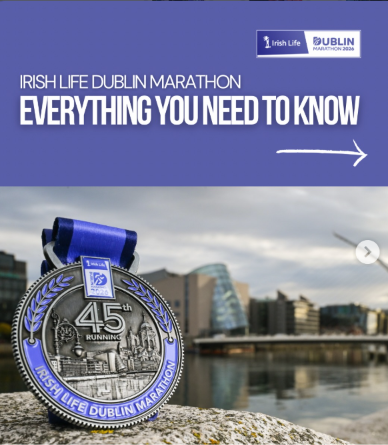
Whether you’re taking on the #IrishLifeDublinMarathon or focusing on the Dublin Race Series, it’s important to get your landing technique right when running ✅
Once you’ve nailed the proper plank form, challenge yourself with these slight modifications—they’ll help you really tap into all the benefits you can get from spending that time on your hands and forearms.
1. Stop praying
Clasping your hands in a forearm plank makes the exercise feel easier—but that means you’re not maxing out the benefits. “It can also promote a rounded posture instead of a stable, upright one,” says O’Brien, and that’s the opposite of what you’re going for in this position. Instead, press your palms into the floor. “That will create more shoulder engagement and stability as a bonus.”
2. Stay up
A straight arm plank is going to be more challenging, says O’Brien. “Dropping to the elbows can help you maintain proper form because it’s easier to hold,” she says. It’s a great option for someone who isn’t yet strong enough to maintain an engaged core and flat back (it also takes some of the work off of the shoulders, if that’s a problem area for you).
3. Don’t hold your breath
It’s tempting to grit your teeth as you hold the pose, but you want to inhale and exhale steadily throughout. “Breathing will help you consciously engage the transverse abdominis muscle,” says DuFlo. “If you see your belly doming or bulging outward along midline, it means you are likely not engaging this correctly or holding your breath.”
If holding a plank for a minute or more is easy for you, place your palms, forearms, or feet on a pillow, BOSU ball, Swiss ball, or other unstable surface. “That can kick on the deeper core, the transverse abdominis, in a different way, and just add an additional challenge to your other muscles,” says DuFlo.
5. Switch it up
There are tons of ways to make a plank more challenging, in addition to targeting other muscles that will help your running form. Spider planks (bringing your knee to tap the same shoulder) and windshield wiper planks (where you extend one leg at a time out towards the hip) help with the hip rotator muscles, for example, while reverse planks activate the glutes and stretch the chest, says O’Brien. Just make sure you can maintain good form while doing these harder variations.
Q: Is running a marathon good for my health? A: First-time marathon runners significantly improve their cardiovascular health during training. The key is to aim for at least 30 min of moderate-intensity activity 5 days a week. https://mayocl.in/37hrf1Y#MayoClinicQandA#tcmarathon
DEAR MAYO CLINIC: A few neighbors formed a running group to train for a marathon in 2021. I’m thinking about joining them as I know that running can be good exercise, but I’ve never run before. Is running a marathon actually good for my health? Should I do certain things to avoid injuries?
ANSWER: Being active and engaging in regular aerobic exercise is important for overall heart health and wellness. Typically, 30 minutes of moderate intensity activity five days a week is recommended for most healthy adults. Running is a simple, low-cost exercise, and you should be commended for starting a new exercise regimen.
As a first-time runner, I’d recommend that you talk with your health care provider about any concerns, especially if you have any health conditions, such as high blood pressure, heart issues or a history of prior musculoskeletal injuries. Ask your health care provider about any symptoms that you might want to watch for when you run.
Before starting out, I would suggest you invest in a good pair of running shoes and make sure that you warm up and stretch prior to any run. Focus on cross training with exercises that strengthen your hips and core.
If your neighbors are seasoned runners, you may want to consider joining a training program to help you build stamina and increase your mileage over time.
As a novice runner, a marathon may sound overwhelming, but recent research shows that it really could be the key to better health. A study out of the United Kingdom showed first-time marathon runners significantly improved their cardiovascular health during training for a 26.2-mile race.
Specifically, this study showed participants had improvements in overall cardiovascular health but particularly related to the stiffness of the aortic vessel. This is important because as people age, the body’s vessels become stiffer. This can be detrimental to your health since with stiff vessels your body has to work harder to pump blood.
In addition to runners having a substantial decrease in the stiffness of the aortic vessel, which moves blood throughout our body, the study found marathon training improved blood pressure.
The study looked at marathon runners six months prior to training and three week after they completed the London Marathon. On average, the subjects ran about 6 to 13 miles in training per week.
If running a marathon seems too daunting, consider a half marathon or a 5K. The cardiovascular benefits of running remain, no matter the distance. One of the most interesting findings of the UK study was that the slowest runners had the greatest improvements in cardiovascular health.
If running is not enjoyable or you have other issues — let’s say your knees or back make it challenging to run — you can still benefit from lacing up your sneakers. Walking regularly at a brisk pace can result in improvements in overall cardiovascular health and vessel stiffness.
Whatever activity you chose, the key is that you want to aim for at least 30 minutes of moderate intensity activity five days a week. Walking or running with the neighbors is a great way to combine exercise and socialization. And if you’re wondering about the definition of moderate intensity, you should be able to carry on a conversation, but you should not be able to carry a tune. —Dr. Sara Filmalter, Family and Sports Medicine, Mayo Clinic, Jacksonville, Florida
Once you’ve nailed the proper plank form, challenge yourself with these slight modifications—they’ll help you really tap into all the benefits you can get from spending that time on your hands and forearms.
1. Stop praying
Clasping your hands in a forearm plank makes the exercise feel easier—but that means you’re not maxing out the benefits. “It can also promote a rounded posture instead of a stable, upright one,” says O’Brien, and that’s the opposite of what you’re going for in this position. Instead, press your palms into the floor. “That will create more shoulder engagement and stability as a bonus.”
2. Stay up
A straight arm plank is going to be more challenging, says O’Brien. “Dropping to the elbows can help you maintain proper form because it’s easier to hold,” she says. It’s a great option for someone who isn’t yet strong enough to maintain an engaged core and flat back (it also takes some of the work off of the shoulders, if that’s a problem area for you).
3. Don’t hold your breath
It’s tempting to grit your teeth as you hold the pose, but you want to inhale and exhale steadily throughout. “Breathing will help you consciously engage the transverse abdominis muscle,” says DuFlo. “If you see your belly doming or bulging outward along midline, it means you are likely not engaging this correctly or holding your breath.”
If holding a plank for a minute or more is easy for you, place your palms, forearms, or feet on a pillow, BOSU ball, Swiss ball, or other unstable surface. “That can kick on the deeper core, the transverse abdominis, in a different way, and just add an additional challenge to your other muscles,” says DuFlo.
5. Switch it up
There are tons of ways to make a plank more challenging, in addition to targeting other muscles that will help your running form. Spider planks (bringing your knee to tap the same shoulder) and windshield wiper planks (where you extend one leg at a time out towards the hip) help with the hip rotator muscles, for example, while reverse planks activate the glutes and stretch the chest, says O’Brien. Just make sure you can maintain good form while doing these harder variations.

 https://bit.ly/2RSGuWy