Planks are key for building core strength and stability, which help you run stronger longer. These simple tips make a big impact.@WomensRunning

How to Improve Your Basic Plank

Once you’ve nailed the proper plank form, challenge yourself with these slight modifications—they’ll help you really tap into all the benefits you can get from spending that time on your hands and forearms.

1. Stop praying

Clasping your hands in a forearm plank makes the exercise feel easier—but that means you’re not maxing out the benefits. “It can also promote a rounded posture instead of a stable, upright one,” says O’Brien, and that’s the opposite of what you’re going for in this position. Instead, press your palms into the floor. “That will create more shoulder engagement and stability as a bonus.”

2. Stay up

A straight arm plank is going to be more challenging, says O’Brien. “Dropping to the elbows can help you maintain proper form because it’s easier to hold,” she says. It’s a great option for someone who isn’t yet strong enough to maintain an engaged core and flat back (it also takes some of the work off of the shoulders, if that’s a problem area for you).

3. Don’t hold your breath

It’s tempting to grit your teeth as you hold the pose, but you want to inhale and exhale steadily throughout. “Breathing will help you consciously engage the transverse abdominis muscle,” says DuFlo. “If you see your belly doming or bulging outward along midline, it means you are likely not engaging this correctly or holding your breath.”

RELATED: 5 Strength Training Myths for Runners (and the Truth Behind Them) 

4. Plank on an unstable surface

If holding a plank for a minute or more is easy for you, place your palms, forearms, or feet on a pillow, BOSU ball, Swiss ball, or other unstable surface. “That can kick on the deeper core, the transverse abdominis, in a different way, and just add an additional challenge to your other muscles,” says DuFlo.

5. Switch it up

There are tons of ways to make a plank more challenging, in addition to targeting other muscles that will help your running form. Spider planks (bringing your knee to tap the same shoulder) and windshield wiper planks (where you extend one leg at a time out towards the hip) help with the hip rotator muscles, for example, while reverse planks activate the glutes and stretch the chest, says O’Brien. Just make sure you can maintain good form while doing these harder variations.

RELATED: I Completely Swear By This 3-Move Core-Strengthening Sequence

0

Oatmeal Is Still the World’s Best Recovery Food @WomensRunning

Women’s Running

@WomensRunning

Sure, it’s old fashioned. But it’s also nutritional rocket fuel, and athletes are making it taste great. Here’s how.

February 28, 2023 Wes Judd

In a world of green juice and chia seed pudding, this age-old dish is the original, and perhaps most powerful, superfood, especially for athletes competing at the highest levels.

“I’ve asked a lot of elite endurance athletes about their breakfast foods, particularly before races, and oatmeal comes up again and again and again,” says Matt Fitzgerald, endurance coach, nutritionist, and author of The Endurance Diet.

You’re most likely to see oatmeal served with a ton of fixin’s, but even a bowl of plain oats holds its own as a nutritional panacea. Oatmeal is a whole grain (unless you buy oat bran—just part of the seed—as opposed to rolled oats) filled with key vitamins and minerals, a low-glycemic carb that provides lasting energy for your workout and helps fuel recovery without causing a sugar crash, and high in fiber to aid your digestive and metabolic systems.

But a bowl of oats is also a big blank canvas, ready to be combined with a truckload of other high-quality, nutritious ingredients that make it even better training food. “That’s one of oatmeal’s great virtues. You can take it in so many directions,” says Fitzgerald.

Even energy bar companies use it. Picky Bars have Picky Oats, a lineup of better-for-the-athlete instant oatmeal chock-full of real ingredients to support performance, rather than added sugars or fake health foods. “I literally believe that besides energy bars, oatmeal is the next most pervasive food for athletes,” says Jesse Thomas, former professional triathlete and Picky Bars CEO.

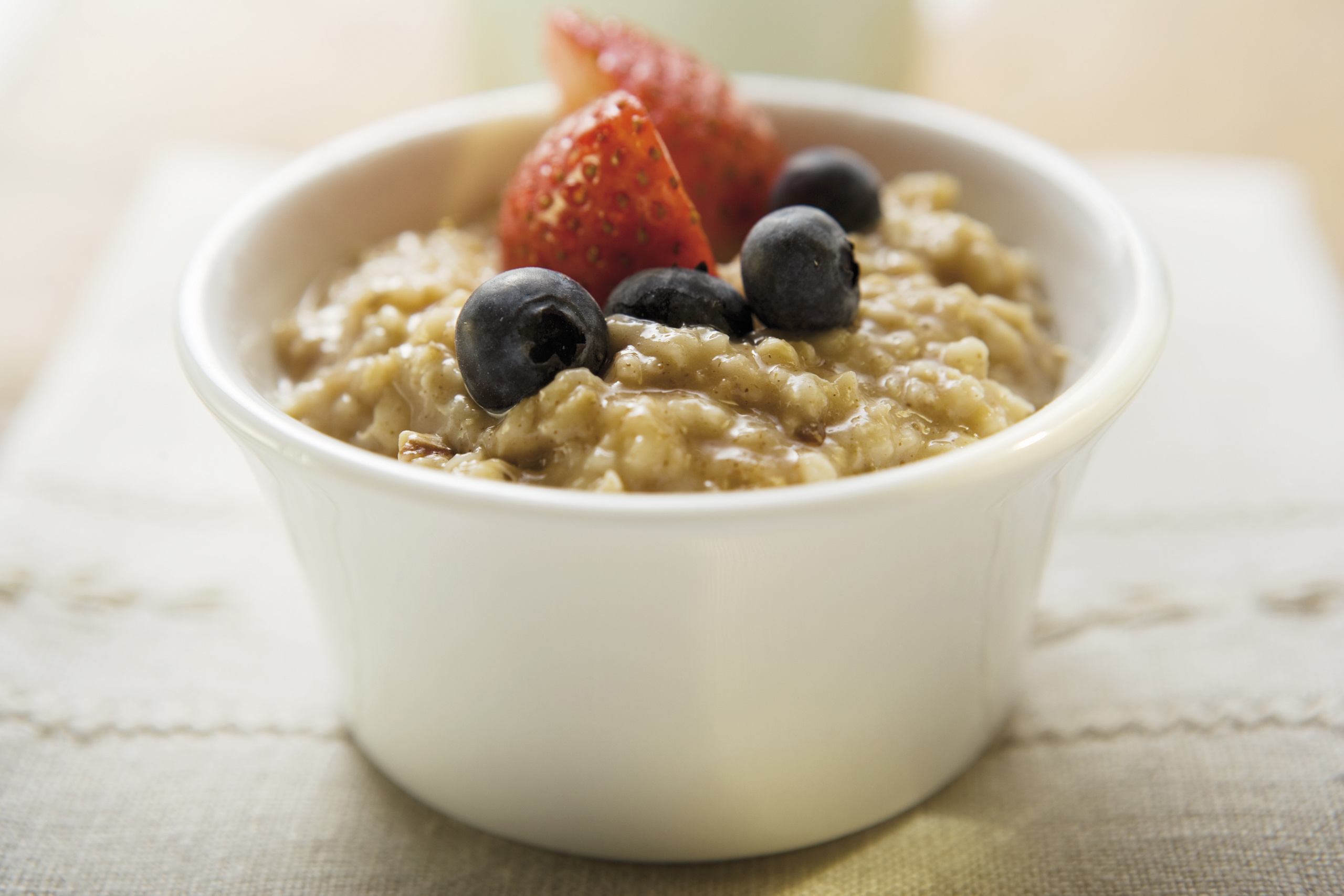
It’s easy to make. All you have to do is boil a ratio of 1/2 cup rolled oats to one cup liquid—either water or a milk of your choice—and top it with whatever you need that day. (For steel-cut oats, change the ratio to 1/4 cup oats to one cup liquid.) Here’s how six athletes do it.

RELATED: Healthy Delicious Baked Oatmeal