Knead, stretch, awaken your qi: here’s the right way to tackle recovery..@WomensRunning

Toward the end of a long run your calf is in a knot the size of a grapefruit. Is this an over-excited neuron taking out its anxiety on a muscle? Or is your qi depleted? You may need a new recovery technique.

Western hemisphere physios of yore saw the body as an organization of bones, muscles, fascia, and nerves, so bodywork that originated there, like Swedish massage, attempts to heal and realign those parts.

Eastern folk saw the body as a vessel of energy and breath. Bodywork that grew out of that philosophy, like acupressure, sought to open blocked energy pathways and restore balance.

Here’s a quick look at three types of bodywork from around the world—three philosophies—that can be used as prevention during training, or for recovery from an injury or race.

Recovery Modalities From Around The World

Shiatsu
Origin: Japan

Shiatsu is based on theories of acupuncture and Chinese medicine that were imported to Japan around 5 AD. According to Cari Johnson Pelava, director of Centerpoint Massage & Shiatsu Therapy School & Clinic, in Minneapolis, a system of energy, “qi,” runs through the body on pathways, and along those pathways lie points where one can access that energy to make a difference in the body. Symptoms like pain or fatigue are said to be caused by an imbalance of energy. By applying pressure, kneading, and stretching, a shiatsu therapist can restore the body’s energy balance.

“We’ve worked with triathletes pre-event and post,” Johnson Pelava says. “Pre-event we’ll focus on tonifying energy so that it’s most accessible to the athlete on event day. We’ll do stretching, hip rotations, and other range of motion work to open energetic pathways. Post-event, we’ll work deeper to pull that energy that’s been depleted back.”

Thai Yoga
Origin: Thailand

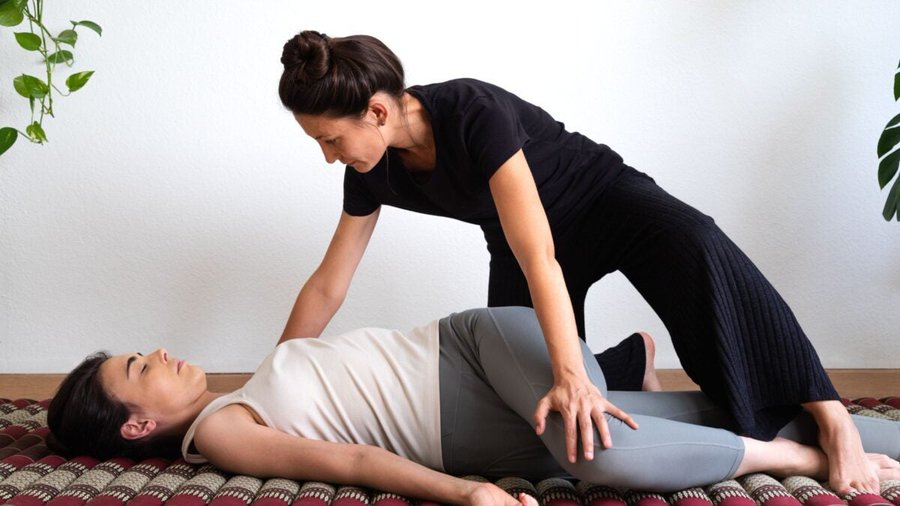
Thai yoga bodywork has an eastern flavor informed by yoga, Ayurveda, and Buddhism. It combines rhythmic massage, assisted yoga poses, acupressure along energy meridians, healing energy work, and meditation.

Tanya Boigenzahn, director of Devanadi School of Yoga and Wellness in Minneapolis, says Thai yoga bodywork can help athletes with flexibility, alignment, and breath control, as well as their mental game—mood, concentration, confidence.

Thai yoga is accomplished in a one-on-one session with clothes on. The therapist moves a passive client through positions, stretching tight areas, and encouraging range of motion and mindful breathwork.

Boigenzahn says Thai yoga helps optimize training pre-event, and eases recovery afterward. “Athletes can expect to have a quicker bounce back time, as well as less discomfort after a tough event.”

Rolfing
Origin: USA

Ida Rolf thought that pain, inefficient movement, and imbalance was were the result of the body being improperly organized around its axis. In New York during the 1940s, Rolf began reorganizing clients’ bodies by manipulating fascia—the connective tissue separating muscles and other organs— which developed into the therapeutic approach called Rolfing Structural Integration. “It’s a combination of participatory bodywork and active experimentation with body movement education,” says Kevin McCarthy, an advanced rolfer with In|Form Rolfing in Minneapolis. “We teach clients how to be aware of and work with their body for better function.”

Rolfing is a holistic approach that seeks to find the source of the dysfunction rather than merely treat the symptom. “Participatory” is a key word, McCarthy says.

“Unlike most forms of massage where you’re lying passively on a table, we’re asking, ‘Can you stand up using the outside of your leg? Do you notice the difference in how that feels?’” he says. “We’re using the body to repattern the brain.”

Because it involves education, rolfing is not a one-and-done—a rolfing treatment is actually usually a series of 10 sessions.

Helen Steele – Into the Wild. @dunnesstores #outdoors

https://www.instagram.com/reel/DGXhvwEincu/?igsh=MThrMDY0eWRreHNidw==

dunnesstores

Original audio

Liked by eallen013 and others

  • dunnesstores
  • Unleash your wild side with Helen Steele’s NEW collection, Into the Wild. Think bold prints, vibrant colours and high-energy designs made for movement. From printed and colour-blocked fleeces to graphic hoodies, performance tees and leggings, each piece is designed to embody freedom and adventure.

    @helensteelefash #IntoTheWild #HelenSteele

What Happens When You Stretch? @Yoga_Journal #runners

For years we were told that we were rubber bands—that if we didn’t stretch we’d turn crusty and snap from disuse. Then we were told that tension was good and that if we were overstretched, we’d be akin to a loose and useless rubber band. And now you might be feeling more like a yo-yo than a rubber band. 

So what’s the actual deal with stretching? What does it do for runners? And when should it be utilized?  Well, that depends on what type of stretching you’re talking about. 

Static vs. Dynamic Stretching

In regards to the rubber band analogy, David Behm, professor in the School of Human Kinetics and Recreation at Memorial University of Newfoundland, describes stretching to be more of a Goldilocks scenario: “You want a tighter but not too tight muscle and tendon,” he says. Static and dynamic stretching serve different purposes in helping your body reach that homeostasis needed to keep running efficiently.  

Static stretching usually involves moving a joint as far as it will comfortably go and then holding it. A static hold can last 30 seconds or more. It’s a very effective way to increase range of motion, relax muscles, and prevent post-exercise stiffness and soreness. Hurdler stretches or kneeling hip flexor stretches are considered static. 

Dynamic stretches are controlled, active movements aimed at helping your muscles rehearse the type of movement they’ll be doing while running. This kind of stretching activates the muscle, causing it to contract and physically warm up. “It also warms up and prepares the nervous system by increasing its activity in anticipation of the activity,” says Behm. Walking lunges, leg swings, and heel to sky pulses are all examples of a dynamic stretch. 

But stretching isn’t just about your muscles and tendons. A study, published recently in the Journal of Physical Activity and Health, found that stretching can also lower blood pressure by physically stretching the blood vessels. The authors found that stretching was more effective in doing so than walking was, a common intervention prescribed for people with hypertension. 

When Should Runners Stretch?

When just fitting the run into your schedule is hard enough, you might be tempted to cut corners in your warm-up and cool-down routines. But here’s why you should consider keeping up stretching. 

Stretching Before a Run

Stretching as part of a warm-up seems to be where the most confusion comes in. It’s a common question: Should you stretch before running? 

Static stretching, when held in long durations, can actually cause you to tense up and get tighter, which is not what you want right before going for a run. “A static stretch would be great if we were about to go hold a static position for an hour. But when we’re running we’re about to go do repeated muscle firing for a set duration. We need to be getting our bodies ready for that physiological movement, not a 30 second static hold,” says Mackenzie Wartenberger, head coach of the University of Wisconsin’s women’s cross country team and assistant track and field coach.

Instead she recommends focusing on dynamic stretches as part of your warm-up routine. The idea is to push your range of motion. “It’s all about pushing right to the point where you can feel it — it should feel a little bit like you’re on the edge of that range of motion—and then immediately backing off,” she says. That process should be repeated three to five times, aiming to go two percent deeper on each repetition. “That contraction or extension depending on what movement you’re doing that’s rapid and repeated, warms your muscles up and it gets your muscles and tendons firing.”

Nell Rojas, a strength and running coach and pro runner herself, agrees that dynamic stretching should be incorporated into the mobility work in a warm-up. “It kind of tricks your muscles, neuromuscularly, to relax,” she says. “You’re not getting any lengthening in your muscles, but your body will be able to relax a little bit.” 

Behm’s research has showed that some static stretching in a warm-up is fine. Some coaches like to incorporate a static hip stretch into the warm-up, for example. “If static stretching is incorporated within a full warm-up, there are trivial effects on performance,” he says. “Static stretching can decrease muscle and tendon injuries, especially with explosive actions, but stretching does not decrease the incidence of all cause injuries.”

YogaJournal.com

Unleash your wild side with Helen Steele’s NEW collection, Into the Wild. @dunnesstores #HelenSteele

https://www.instagram.com/reel/DGXhvwEincu/?igsh=MThrMDY0eWRreHNidw==

dunnesstores

Original audio

Liked by eallen013 and others

  • dunnesstores
  • Unleash your wild side with Helen Steele’s NEW collection, Into the Wild. Think bold prints, vibrant colours and high-energy designs made for movement. From printed and colour-blocked fleeces to graphic hoodies, performance tees and leggings, each piece is designed to embody freedom and adventure.

    @helensteelefash #IntoTheWild #HelenSteele