fyffes_ireland
Looking for a healthy snack? This Fyffes Banana, Almond and Kale Smoothie is perfect at any time of day. 🙌
.
.
.
.
#smoothie #healthylifestyle #breakfasttime #postworkout #preworkout
Health & Wellbeing

Once you’ve nailed the proper plank form, challenge yourself with these slight modifications—they’ll help you really tap into all the benefits you can get from spending that time on your hands and forearms.
Clasping your hands in a forearm plank makes the exercise feel easier—but that means you’re not maxing out the benefits. “It can also promote a rounded posture instead of a stable, upright one,” says O’Brien, and that’s the opposite of what you’re going for in this position. Instead, press your palms into the floor. “That will create more shoulder engagement and stability as a bonus.”
A straight arm plank is going to be more challenging, says O’Brien. “Dropping to the elbows can help you maintain proper form because it’s easier to hold,” she says. It’s a great option for someone who isn’t yet strong enough to maintain an engaged core and flat back (it also takes some of the work off of the shoulders, if that’s a problem area for you).
It’s tempting to grit your teeth as you hold the pose, but you want to inhale and exhale steadily throughout. “Breathing will help you consciously engage the transverse abdominis muscle,” says DuFlo. “If you see your belly doming or bulging outward along midline, it means you are likely not engaging this correctly or holding your breath.”
RELATED: 5 Strength Training Myths for Runners (and the Truth Behind Them)
If holding a plank for a minute or more is easy for you, place your palms, forearms, or feet on a pillow, BOSU ball, Swiss ball, or other unstable surface. “That can kick on the deeper core, the transverse abdominis, in a different way, and just add an additional challenge to your other muscles,” says DuFlo.
There are tons of ways to make a plank more challenging, in addition to targeting other muscles that will help your running form. Spider planks (bringing your knee to tap the same shoulder) and windshield wiper planks (where you extend one leg at a time out towards the hip) help with the hip rotator muscles, for example, while reverse planks activate the glutes and stretch the chest, says O’Brien. Just make sure you can maintain good form while doing these harder variations.
RELATED: I Completely Swear By This 3-Move Core-Strengthening Sequence
0
Once you’ve nailed the proper plank form, challenge yourself with these slight modifications—they’ll help you really tap into all the benefits you can get from spending that time on your hands and forearms.
Clasping your hands in a forearm plank makes the exercise feel easier—but that means you’re not maxing out the benefits. “It can also promote a rounded posture instead of a stable, upright one,” says O’Brien, and that’s the opposite of what you’re going for in this position. Instead, press your palms into the floor. “That will create more shoulder engagement and stability as a bonus.”
A straight arm plank is going to be more challenging, says O’Brien. “Dropping to the elbows can help you maintain proper form because it’s easier to hold,” she says. It’s a great option for someone who isn’t yet strong enough to maintain an engaged core and flat back (it also takes some of the work off of the shoulders, if that’s a problem area for you).
It’s tempting to grit your teeth as you hold the pose, but you want to inhale and exhale steadily throughout. “Breathing will help you consciously engage the transverse abdominis muscle,” says DuFlo. “If you see your belly doming or bulging outward along midline, it means you are likely not engaging this correctly or holding your breath.”
RELATED: 5 Strength Training Myths for Runners (and the Truth Behind Them)
If holding a plank for a minute or more is easy for you, place your palms, forearms, or feet on a pillow, BOSU ball, Swiss ball, or other unstable surface. “That can kick on the deeper core, the transverse abdominis, in a different way, and just add an additional challenge to your other muscles,” says DuFlo.
There are tons of ways to make a plank more challenging, in addition to targeting other muscles that will help your running form. Spider planks (bringing your knee to tap the same shoulder) and windshield wiper planks (where you extend one leg at a time out towards the hip) help with the hip rotator muscles, for example, while reverse planks activate the glutes and stretch the chest, says O’Brien. Just make sure you can maintain good form while doing these harder variations.
RELATED: I Completely Swear By This 3-Move Core-Strengthening Sequence
0
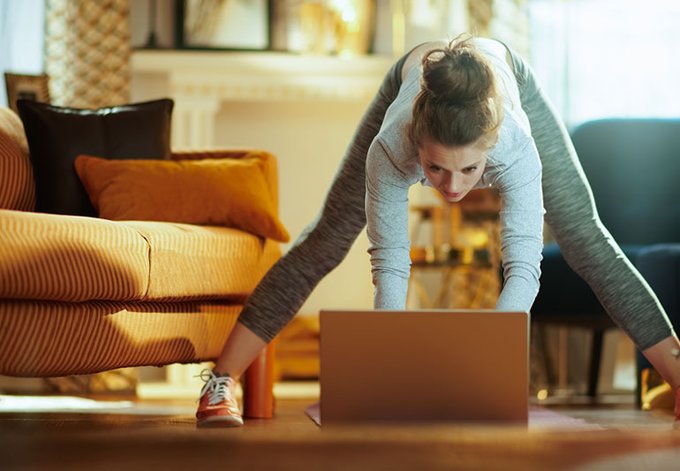
Whether you’re a fitness fanatic or casual gym goer, the thought of picking up a dumbbell covered in germs is enough to make anyone cringe. And with the spread of coronavirus (COVID-19) becoming more prominent every day, gyms and fitness centers across the country are closing their doors to help protect members.
If staying active is an important part of your life (as it should be!) you might be wondering how you’re supposed to go about this whole at-home workout thing. Thankfully, it’s easier than you think.
“A lot of what you’ll find with at-home workouts is about maintaining your current level of fitness,” explains exercise physiologist Katie Lawton. “And with workouts, consistency is key.”
Here Lawton shares some practical advice about how to stay active at home.
Once you’ve nailed the proper plank form, challenge yourself with these slight modifications—they’ll help you really tap into all the benefits you can get from spending that time on your hands and forearms.
Clasping your hands in a forearm plank makes the exercise feel easier—but that means you’re not maxing out the benefits. “It can also promote a rounded posture instead of a stable, upright one,” says O’Brien, and that’s the opposite of what you’re going for in this position. Instead, press your palms into the floor. “That will create more shoulder engagement and stability as a bonus.”
A straight arm plank is going to be more challenging, says O’Brien. “Dropping to the elbows can help you maintain proper form because it’s easier to hold,” she says. It’s a great option for someone who isn’t yet strong enough to maintain an engaged core and flat back (it also takes some of the work off of the shoulders, if that’s a problem area for you).
It’s tempting to grit your teeth as you hold the pose, but you want to inhale and exhale steadily throughout. “Breathing will help you consciously engage the transverse abdominis muscle,” says DuFlo. “If you see your belly doming or bulging outward along midline, it means you are likely not engaging this correctly or holding your breath.”
RELATED: 5 Strength Training Myths for Runners (and the Truth Behind Them)
If holding a plank for a minute or more is easy for you, place your palms, forearms, or feet on a pillow, BOSU ball, Swiss ball, or other unstable surface. “That can kick on the deeper core, the transverse abdominis, in a different way, and just add an additional challenge to your other muscles,” says DuFlo.
There are tons of ways to make a plank more challenging, in addition to targeting other muscles that will help your running form. Spider planks (bringing your knee to tap the same shoulder) and windshield wiper planks (where you extend one leg at a time out towards the hip) help with the hip rotator muscles, for example, while reverse planks activate the glutes and stretch the chest, says O’Brien. Just make sure you can maintain good form while doing these harder variations.
RELATED: I Completely Swear By This 3-Move Core-Strengthening Sequence
0
Whether you’re a fitness fanatic or casual gym goer, the thought of picking up a dumbbell covered in germs is enough to make anyone cringe. And with the spread of coronavirus (COVID-19) becoming more prominent every day, gyms and fitness centers across the country are closing their doors to help protect members.
If staying active is an important part of your life (as it should be!) you might be wondering how you’re supposed to go about this whole at-home workout thing. Thankfully, it’s easier than you think.
“A lot of what you’ll find with at-home workouts is about maintaining your current level of fitness,” explains exercise physiologist Katie Lawton. “And with workouts, consistency is key.”
Here Lawton shares some practical advice about how to stay active at home.
Whether you’re a fitness fanatic or casual gym goer, the thought of picking up a dumbbell covered in germs is enough to make anyone cringe. And with the spread of coronavirus (COVID-19) becoming more prominent every day, gyms and fitness centers across the country are closing their doors to help protect members.
If staying active is an important part of your life (as it should be!) you might be wondering how you’re supposed to go about this whole at-home workout thing. Thankfully, it’s easier than you think.
“A lot of what you’ll find with at-home workouts is about maintaining your current level of fitness,” explains exercise physiologist Katie Lawton. “And with workouts, consistency is key.”
Here Lawton shares some practical advice about how to stay active at home.