Yoga Journal
@Yoga_Journal
·
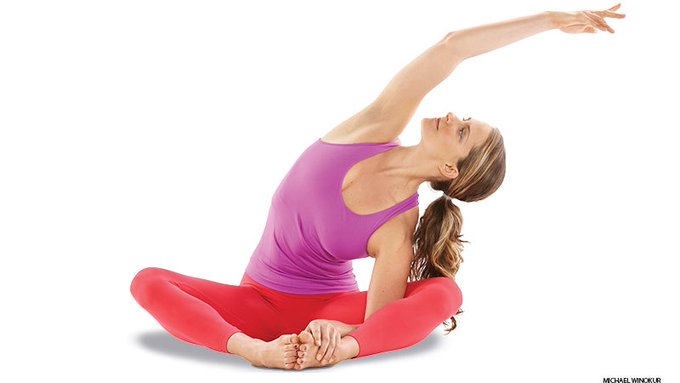
This sequence is designed to help you ease tension by putting your spine through its full range of motion.
Health & Wellbeing

·
We have a hunch that sitting too much (and staring at your phone) is doing a number on your back and shoulders. Here are 7 sequences that will help you avoid tech neck and hump back.

For years we were told that we were rubber bands—that if we didn’t stretch we’d turn crusty and snap from disuse. Then we were told that tension was good and that if we were overstretched, we’d be akin to a loose and useless rubber band. And now you might be feeling more like a yo-yo than a rubber band.
So what’s the actual deal with stretching? What does it do for runners? And when should it be utilized? Well, that depends on what type of stretching you’re talking about.
In regards to the rubber band analogy, David Behm, professor in the School of Human Kinetics and Recreation at Memorial University of Newfoundland, describes stretching to be more of a Goldilocks scenario: “You want a tighter but not too tight muscle and tendon,” he says. Static and dynamic stretching serve different purposes in helping your body reach that homeostasis needed to keep running efficiently.
Static stretching usually involves moving a joint as far as it will comfortably go and then holding it. A static hold can last 30 seconds or more. It’s a very effective way to increase range of motion, relax muscles, and prevent post-exercise stiffness and soreness. Hurdler stretches or kneeling hip flexor stretches are considered static.
Dynamic stretches are controlled, active movements aimed at helping your muscles rehearse the type of movement they’ll be doing while running. This kind of stretching activates the muscle, causing it to contract and physically warm up. “It also warms up and prepares the nervous system by increasing its activity in anticipation of the activity,” says Behm. Walking lunges, leg swings, and heel to sky pulses are all examples of a dynamic stretch.
But stretching isn’t just about your muscles and tendons. A study, published recently in the Journal of Physical Activity and Health, found that stretching can also lower blood pressure by physically stretching the blood vessels. The authors found that stretching was more effective in doing so than walking was, a common intervention prescribed for people with hypertension.
When just fitting the run into your schedule is hard enough, you might be tempted to cut corners in your warm-up and cool-down routines. But here’s why you should consider keeping up stretching.
Stretching as part of a warm-up seems to be where the most confusion comes in. It’s a common question: Should you stretch before running?
Static stretching, when held in long durations, can actually cause you to tense up and get tighter, which is not what you want right before going for a run. “A static stretch would be great if we were about to go hold a static position for an hour. But when we’re running we’re about to go do repeated muscle firing for a set duration. We need to be getting our bodies ready for that physiological movement, not a 30 second static hold,” says Mackenzie Wartenberger, head coach of the University of Wisconsin’s women’s cross country team and assistant track and field coach.
Instead she recommends focusing on dynamic stretches as part of your warm-up routine. The idea is to push your range of motion. “It’s all about pushing right to the point where you can feel it — it should feel a little bit like you’re on the edge of that range of motion—and then immediately backing off,” she says. That process should be repeated three to five times, aiming to go two percent deeper on each repetition. “That contraction or extension depending on what movement you’re doing that’s rapid and repeated, warms your muscles up and it gets your muscles and tendons firing.”
Nell Rojas, a strength and running coach and pro runner herself, agrees that dynamic stretching should be incorporated into the mobility work in a warm-up. “It kind of tricks your muscles, neuromuscularly, to relax,” she says. “You’re not getting any lengthening in your muscles, but your body will be able to relax a little bit.”
Behm’s research has showed that some static stretching in a warm-up is fine. Some coaches like to incorporate a static hip stretch into the warm-up, for example. “If static stretching is incorporated within a full warm-up, there are trivial effects on performance,” he says. “Static stretching can decrease muscle and tendon injuries, especially with explosive actions, but stretching does not decrease the incidence of all cause injuries.”
YogaJournal.com


5 Poses to Strengthen Your Lower Back and Core—All Without Standing Up
If there is one thing I have learned again and again in the last year and a half, it is how quickly the nervous system can settle down simply by lying on the floor.
When yoga studios abruptly shut down a year and a half ago, it was the first time in 22 years I had zero pressure to practice yoga. I was no longer responsible for instructing several yoga classes a week, leading teacher trainings, and mentoring new teachers. During the first week or so of no in-studio classes, I thought, “what a great opportunity to finally take a break from yoga.”
By my third week of doing as little as possible, everything hurt and I felt like complete garbage. I’d conveniently forgotten how much I needed yoga. I practiced yoga regularly not only to take care of myself, but also because it inspires me, keeps me curious, and informs my teaching. My home practice was essential to my being able to effectively share yoga with students.
Even after that realization, on more days than I care to admit, I struggled to do yoga on my own. I would intend to practice but then curl up on my sofa and mindlessly scroll on my phone. Even though I knew that moving would improve my mood, I found that getting onto my mat felt monumental. It was as if there was a force field holding me back from doing the one thing that makes me feel better.
I still find it challenging to practice. I’ve come to understand, though, that when I start with the support of the floor against my back, I instantly feel better. I bend my knees, place my feet flat on the mat, close my eyes, and my attention immediately shifts to my breath. The moment I come back to my breath, my frazzled nervous system begins to settle. The quality of my breath changes and something inside me softens. My body feels better, my mind has more clarity, and everything in life seems more tolerable.

 Fitnessaware